
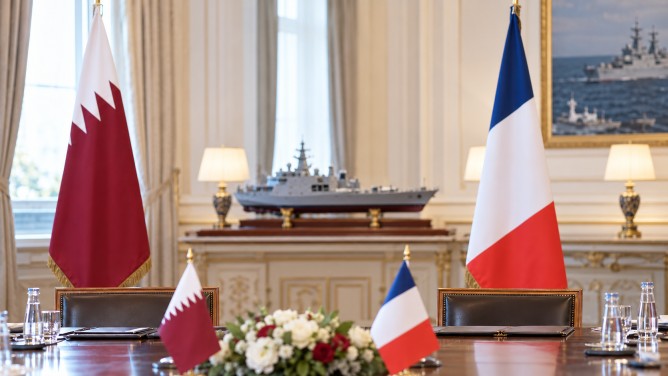
French President Emmanuel Macron’s recent visit to Doha on October 20–21, 2026, has reinforced the strategic partnership between Qatar and France, with a renewed emphasis on defence and security collaboration. During discussions with Qatar’s Amir Sheikh Tamim bin Hamad Al Thani, both leaders committed to enhancing bilateral ties across multiple domains, notably defence, security, trade, energy, and investment.
Defence cooperation was a focal point of the talks, as the two countries agreed to broaden military collaboration. This includes joint training initiatives, bolstering land-force capabilities, and enhancing air defence systems. A significant development is the signing of a letter of intent to select KNDS France and John Cockerill Defense for the modernization of Qatar’s land forces. Both nations also expressed a desire to deepen cooperation involving Rafale fighter aircraft, radar systems, communication satellites, and military planning.
Beyond military collaboration, Qatar and France pledged to intensify counterterrorism efforts, strengthen cybersecurity cooperation, and combat illicit financial flows. The leaders highlighted the importance of safeguarding maritime navigation and advocated for diplomatic efforts to reduce regional tensions.
On the economic front, the two countries plan to explore investment opportunities in sectors such as energy, artificial intelligence, digital transformation, cybersecurity, transport, infrastructure, healthcare, and tourism. The discussions underlined the significance of energy security, technological innovation, and sustainable development in their strategic partnership.
The talks also covered regional conflicts, with both leaders reiterating their support for diplomatic solutions and humanitarian assistance in areas like Gaza, Lebanon, Syria, Sudan, Libya, and Yemen. They reaffirmed their backing for a two-state solution to the Israeli-Palestinian conflict, emphasizing the need for regional stability.
In addition, Qatar and France expressed their commitment to expand cooperation in education, research, culture, sports, and tourism, alongside joint humanitarian and development initiatives. These agreements reflect both countries’ intentions to strengthen their strategic relationship and collaborate on key issues like defence, economic growth, and international security.
